Saudi Arabia, Pakistan and Türkiye’s Defence Pact: Global Reaction and the Changing Regional Security Landscape
 By abdullah
Published: 08 Aug 2026
8 min read
By abdullah
Published: 08 Aug 2026
8 min read
Saudi Arabia, Pakistan and Türkiye’s Defence Pact: Global Reaction and the Changing Regional Security Landscape
Hanif Sabir
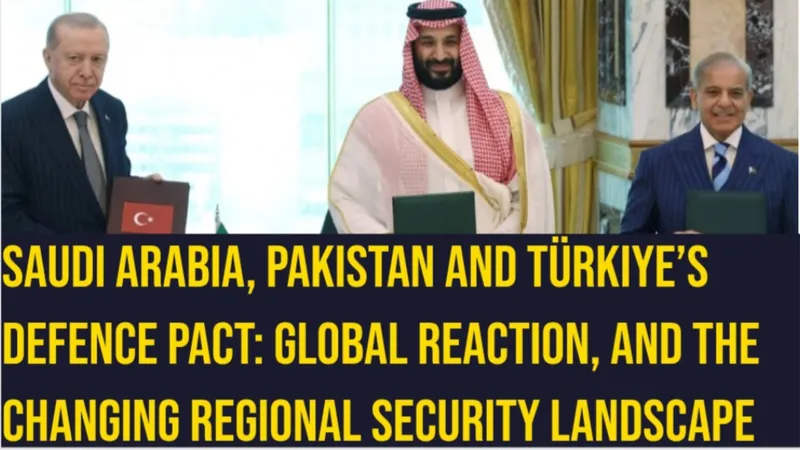
The defence agreement signed by Saudi Arabia, Pakistan and Turkiye in Makkah on August 7 has added a new and potentially important dimension to the security landscape of the Middle East and South Asia.
The agreement, known as the Makkah Joint Defence Agreement, says that an armed attack against any one of the three countries will be treated as an attack against all three. While the full operational details have not yet been made public, the provision has immediately drawn attention because of the strategic weight of the three countries involved.
The agreement is being seen as more than just another defence cooperation document. It brings together Saudi Arabia’s economic and strategic influence, Pakistan’s military experience and Turkiye’s growing defence capabilities under a single framework.
For now, however, it would be premature to describe the arrangement as a new NATO-style alliance. The key question is how the collective-defence commitment will work in practice.
Why Saudi Arabia wanted a stronger regional security arrangement
For Riyadh, the timing of the agreement is significant.
Saudi Arabia has spent years investing heavily in its economy and infrastructure under Vision 2030. Protecting major economic projects, energy facilities and trade routes has therefore become an increasingly important part of its national security strategy.
At the same time, the Middle East has witnessed repeated conflicts and tensions involving missiles, drones and armed groups. Saudi Arabia has traditionally relied heavily on its security relationship with the United States, but the kingdom has also been developing broader partnerships with regional and international powers.
The agreement with Pakistan and Turkiye fits into that wider effort.
Pakistan gains a new strategic opportunity
Pakistan’s relationship with Saudi Arabia is not new. The two countries have maintained close military ties for decades, including cooperation in training and defence.
What makes the new arrangement different is the formal inclusion of Turkiye.
Pakistan and Turkiye already have strong defence relations, including cooperation in naval systems, defence technology and military training. Bringing Saudi Arabia into a framework involving Islamabad and Ankara could open the door to much wider cooperation.
This could eventually include joint exercises, defence production, technology sharing, intelligence cooperation and training programmes.
But there is also a diplomatic challenge for Pakistan.
Islamabad has traditionally maintained relations with both Saudi Arabia and Iran and has tried to avoid becoming part of their regional rivalry. If tensions between Riyadh and Tehran rise again, Pakistan could face difficult choices in maintaining its carefully balanced diplomatic position.
Why Turkiye’s role matters
Turkiye gives the new arrangement another layer of military and technological strength.
The country has developed a powerful domestic defence industry, particularly in drones and other advanced military systems. Its armed forces are also among the largest within NATO.
Saudi Arabia has shown increasing interest in Turkish defence technology and industrial cooperation. This means the agreement could eventually become as much about defence industries and technology as it is about traditional military cooperation.
In other words, the relationship may move from buying weapons to jointly developing and producing them.
India is watching carefully
India’s response has so far been cautious rather than confrontational.
Indian Foreign Ministry spokesperson Randhir Jaiswal said New Delhi was “closely watching” the development.
That wording is significant. India has not announced any immediate countermeasure or new military arrangement in response to the pact. At the same time, the presence of Pakistan in the agreement and its collective-defence clause naturally make the development important for Indian strategic planners.
New Delhi has also pointed to its broad strategic partnership with Saudi Arabia, suggesting that it expects its relationship with Riyadh to remain strong despite the new defence arrangement.
What Indian media is focusing on
Indian media coverage has largely centred on the potential implications of the pact for Pakistan’s regional position and India’s security environment.
Several outlets have highlighted the agreement’s central principle that an attack on one member would be treated as an attack on all three.
The agreement has also generated considerable discussion on social media, including claims that India could seek a counter-defence arrangement with Israel. Such claims, however, should not be treated as established facts without official confirmation.
This distinction is important because the official Indian response so far has been measured.
Iran’s position needs to be treated carefully
Iran is perhaps the country whose strategic calculations could be most closely affected by the new arrangement.
The reason is straightforward: Saudi Arabia and Iran have historically been regional rivals, although their relations have also gone through periods of diplomatic engagement and de-escalation.
The addition of Pakistan and Turkiye to a collective-defence framework naturally raises questions in Tehran about the future regional balance.
But there is an important point that should not be overlooked: at the time of the agreement’s announcement, there was no clearly confirmed Iranian government statement rejecting the pact or issuing a direct threat in response.
A number of claims have circulated through regional and social media platforms, but these should not be presented as Iran’s official position unless they are confirmed by authoritative Iranian sources.
For a news report, separating verified statements from speculation is particularly important in a sensitive regional security story.
How the international media is reading the development
International coverage has generally focused on the agreement as part of a broader change in the Middle East’s security environment.
One interpretation is that Saudi Arabia is seeking greater regional security cooperation rather than depending exclusively on a single external power.
Another is that Pakistan and Turkiye are gaining a more direct role in Gulf security affairs.
There is also considerable interest in what the agreement could mean for Iran and for the wider balance of power between regional blocs.
However, there is still a great deal that remains unknown. The public announcement does not provide all the details of how the three countries would respond militarily if one of them were attacked.
That is why comparisons with NATO’s Article 5 should be made cautiously.
Is this really an “Islamic NATO”?
The phrase “Islamic NATO” has already appeared in some media and social-media discussions.
It is an attention-grabbing description, but it is not the official name or stated purpose of the agreement.
Saudi officials have stressed that the arrangement is not designed to create a military axis or sectarian bloc. For that reason, calling it an “Islamic NATO” at this stage would be more of an interpretation than a factual description.
The real story will be what happens next
The signing ceremony itself is only the beginning.
The real significance of the agreement will become clearer over the coming months as the three countries decide how to put it into practice.
Will they hold more joint military exercises? Will they establish permanent mechanisms for intelligence sharing? Will their defence industries work together? Will there be joint production of drones, naval equipment or other military systems?
And, most importantly, what happens if one of the three countries actually faces a major military attack?
The answers to these questions will determine whether the Makkah agreement remains primarily a political commitment or develops into a functioning regional security mechanism.
A new link between South Asia and the Middle East
Perhaps the most interesting aspect of the agreement is its geography.
Pakistan’s security concerns are largely shaped by South Asia, particularly its relationship with India. Saudi Arabia’s priorities are centred on the Gulf and the wider Middle East. Turkiye, meanwhile, has strategic interests stretching from the Middle East and Mediterranean to the broader NATO security system.
Bringing these three countries together creates a security link between regions that have traditionally been treated separately.
It also reflects a wider trend: regional powers are increasingly trying to build their own networks of security and defence cooperation instead of relying entirely on major global powers.
Conclusion
The Saudi Arabia-Pakistan-Turkiye defence agreement is unlikely to transform the regional security order overnight. But it is an important political and strategic signal.
For Saudi Arabia, it offers another layer of regional security cooperation. For Pakistan, it strengthens its strategic ties with Riyadh while bringing its close relationship with Turkiye into a wider framework. For Turkiye, it creates a stronger foothold in Gulf security and opens further possibilities for defence-industrial cooperation.
India is watching the development carefully, while Iran’s eventual position will be particularly important given the broader regional dynamics.
For now, the most sensible conclusion is also the simplest: the agreement has created a new framework, but its real importance will be measured not by the words signed in Makkah, but by what Saudi Arabia, Pakistan and Turkiye actually do with them.