Chinese Delegation Visits Lahore Chamber to Boost Industrial and Trade Cooperation
 By abdullah
Published: 04 Nov 2026
4 min read

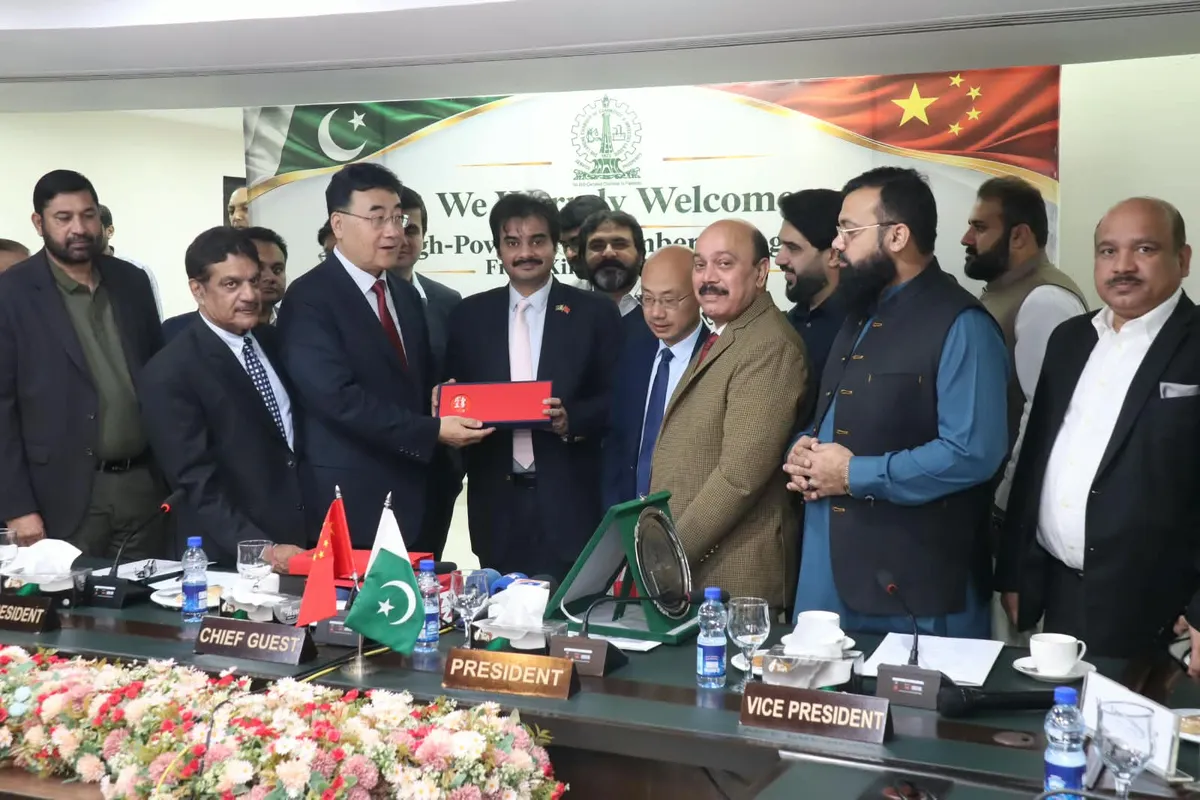
ISLAMABAD (Special Correspondent) – A high-level Chinese delegation from Xinjiang Province visited the Lahore Chamber of Commerce and Industry (LCCI) on 4 November 2026 to explore wide-ranging opportunities for strengthening bilateral trade, investment, and industrial cooperation. The discussions focused particularly on agriculture, textiles, food processing, livestock, technology transfer, cross-border e-commerce, hospitality, tourism, and regional connectivity to deepen economic ties between Pakistan and China.
Key Points
- A high-level Chinese delegation from Xinjiang visited LCCI to discuss bilateral trade and industrial cooperation.
- Delegation leader Ha Zengyou proposed a four-pronged framework covering agriculture, textiles, trade channels, and infrastructure.
- LCCI President Ali Hussam Asghar invited Chinese investors to explore Punjab’s industrial estates and CPEC Special Economic Zones.
- Sardar Usman Ghani proposed establishing a dedicated Chinatown in Lahore for Chinese investors and professionals.
- Former LCCI President Shahzad Ali Malik stressed adopting Chinese expertise to revive Pakistan’s declining cotton production.
Exploring Economic Partnership Frameworks
The visiting delegation was headed by Ha Zengyou, who stated during the session that government-level agreements can only reach their full potential when entrepreneurs and businesses translate them into economically viable projects. He noted that the Xinjiang Production and Construction Corps (XPCC) and Lahore share complementary industrial strengths, providing substantial avenues for cooperation in manufacturing, trade, infrastructure, and agriculture.
Highlighting a structured approach, Ha Zengyou presented a four-pronged framework for cooperation. This framework prioritizes agriculture and food processing, textiles, new trade channels, and regional connectivity and infrastructure. He noted that while Pakistan possesses strong potential in fruits, vegetables, seafood, nuts, and other agricultural yields, XPCC brings advanced expertise in standardized cultivation, livestock raising, agricultural processing, cold-chain storage, and export-oriented supply chains.
Collaborative Avenues in Agriculture and Textiles
Addressing the textile sector, the delegation leader remarked that Pakistan demonstrates significant capabilities in cotton spinning and weaving, whereas XPCC operates an integrated textile industry complemented by downstream processing capacity and a skilled workforce. To support the business community, XPCC offered assistance in navigating Chinese policies, customs procedures, and taxation matters, while proposing a regular communication mechanism between economic zones and chambers of commerce.
LCCI President Ali Hussam Asghar underscored that Pakistan and China share a time-tested friendship that must be operationalized through robust business partnerships and practical economic cooperation. Pointing out that Punjab serves as Pakistan’s agricultural heartland and a vital textile hub, he emphasized mutual interests in water-efficient farming, improved cotton productivity, food processing, packaging, cold-chain facilities, and halal meat production.
Infrastructure Initiatives and Cotton Sector Revival
LCCI Senior Vice President Sardar Usman Ghani underlined Lahore’s strategic location, developed transport network, and access to key trade routes. In a prominent initiative, he proposed establishing a Chinatown in Lahore to offer a dedicated community environment, complete with security arrangements and necessary facilities, for Chinese nationals, professionals, and investors.
Former LCCI President Shahzad Ali Malik drew attention to the strategic importance of cotton, noting that Pakistan’s annual production has dropped from approximately 15 million bales to between 5 and 6 million bales. He stressed the necessity of leveraging China’s expertise in cotton cultivation, seed development, and modern irrigation technologies, citing ongoing collaboration with China’s Jinghua Seed Industry Company as a model for future cooperation with XPCC to strengthen the domestic textile sector.
Frequently Asked Questions
What were the main areas of cooperation discussed during the Chinese delegation’s visit to LCCI?
The discussions focused on agriculture, textiles, food processing, livestock, technology transfer, cross-border e-commerce, hospitality, tourism, and regional connectivity.
What specific proposal was made by LCCI Senior Vice President Sardar Usman Ghani?
Sardar Usman Ghani proposed establishing a Chinatown in Lahore to provide Chinese nationals, professionals, and investors with a dedicated community environment equipped with appropriate security and facilities.
Why is Pakistan currently importing cotton from international markets?
Pakistan’s annual cotton production has historically reached around 15 million bales but has declined to approximately 5 to 6 million bales, forcing the country to import cotton to meet industry requirements.