France, Germany Push EU for Rapid Trade Retaliation System; China Emerges as Likely Target
 By hanif sabir
Published: 07 Oct 2026
5 min read
By hanif sabir
Published: 07 Oct 2026
5 min read
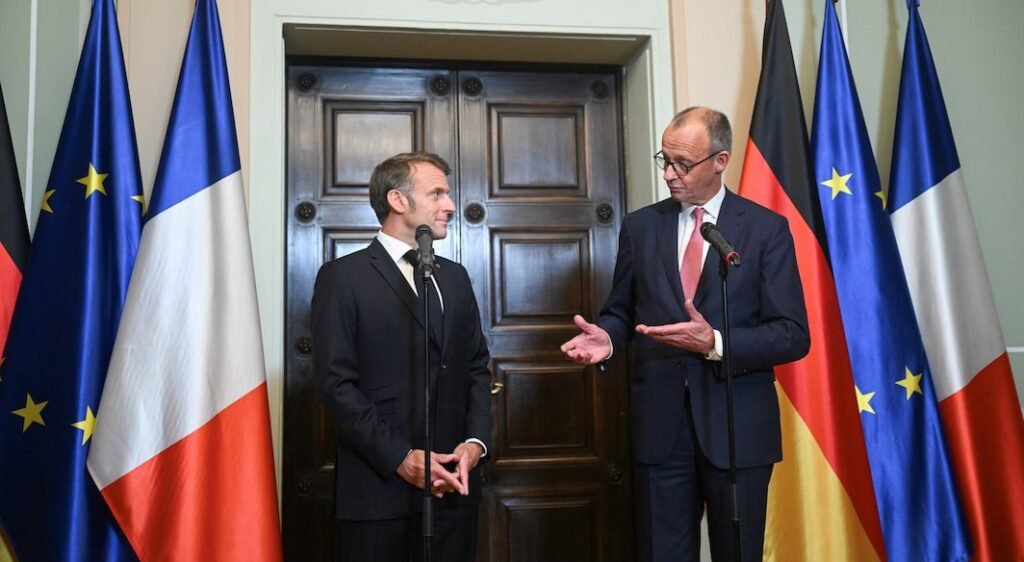
BERLIN/PARIS: France and Germany have called for a new European Union mechanism to enable rapid retaliation against countries whose trade and economic policies are deemed to threaten the bloc’s economy and industrial base, with China emerging as the most likely target of the proposed system.
French President Emmanuel Macron and German Chancellor Friedrich Merz have sent a joint letter to European Commission President Ursula von der Leyen, warning that “systematic policies that distort markets” pose a growing threat to Europe’s economic strength, industrial base, competitiveness and strategic autonomy.
Although the letter does not name any specific country, the proposal comes amid escalating economic tensions between the EU and China over Chinese subsidies, industrial overcapacity, low-priced exports and the widening trade imbalance between the two sides.
France and Germany argue that the EU’s existing trade-defence mechanisms are too slow to respond effectively to serious and coordinated economic pressure. They want Brussels to establish a mechanism capable of triggering countermeasures within days when a third country is judged to be seriously and systematically distorting the European market.
Under the proposed system, the European Commission would be given greater powers to initiate rapid action against a country or companies considered responsible for major market distortions. In particularly serious cases, access to the EU’s single market could potentially be restricted or suspended.
EU member states would retain the ability to block such action, but the Franco-German proposal envisages a qualified-majority voting mechanism, potentially making the decision-making process significantly faster than under existing arrangements.
The proposal is formally designed to apply to any country rather than targeting China specifically. However, it refers to practices including dumping, large-scale state subsidies, industrial overcapacity, currency-related distortions and excessive dominance in particular sectors — issues that have been at the centre of the EU’s long-running trade dispute with Beijing.
France and Germany have also proposed measures to reduce Europe’s excessive dependence on individual countries or a limited number of suppliers. The initiative would seek to diversify supply chains for critical goods, raw materials and industrial products and reduce strategic vulnerabilities caused by excessive dependence on a single country or company.
The two governments are further calling for the EU to strengthen and accelerate its trade-defence instruments, including anti-dumping and anti-subsidy investigations. They want such investigations to be launched more rapidly and, where necessary, expanded from individual products to entire industrial sectors.
Chemicals, PET and hybrid vehicles are among the sectors identified as requiring particular attention.
China’s name may be absent from the Franco-German letter, but the EU’s growing trade deficit with Beijing provides the immediate economic backdrop to the initiative. The European Union says its goods trade deficit with China reached around €360 billion in 2025.
European industrial groups have repeatedly raised concerns over Chinese state subsidies, industrial overcapacity and the growing flow of cheaper Chinese products into the European market, arguing that these practices are placing European manufacturers under increasing pressure.
The Franco-German initiative comes as Brussels and Beijing are simultaneously attempting to manage their increasingly difficult trade relationship through negotiations. EU Trade Commissioner Maroš Šefčovič is due to meet Chinese Commerce Minister Wang Wentao in Beijing on October 8 and 9, with trade imbalances and market access expected to feature prominently in the discussions.
Beijing has already reacted sharply to the Franco-German initiative.
China’s Ministry of Commerce has criticised the proposal as a move towards protectionism, arguing that protectionist policies cannot strengthen competitiveness and warning against attempts to disrupt supply chains or separate economies from one another.
Beijing has urged France and Germany to uphold free trade, open cooperation and World Trade Organization rules rather than pursuing measures that could further fragment global trade.
China’s Foreign Ministry has likewise stressed that China-EU economic and trade relations are based on mutual interests and called for disagreements to be resolved through dialogue and consultation while maintaining the stability of global industrial and supply chains.
German Chancellor Friedrich Merz, however, has stressed that the joint initiative is not directed against any particular country. Berlin and Paris say the objective is to equip the EU with a rapid-response instrument that could be used against unfair trade practices by countries around the world.
Nevertheless, the combination of Europe’s massive trade deficit with China, disputes over Chinese subsidies and industrial overcapacity, and growing European concerns over dependence on Chinese supply chains has made Beijing the obvious focus of attention.
The proposal is not yet EU law. It would have to pass through the bloc’s legislative and approval procedures before becoming operational.
If adopted, the new mechanism could significantly strengthen the European Commission’s ability to respond rapidly to alleged unfair trade practices and could mark a major escalation in the EU’s economic defence strategy — potentially opening a new and more confrontational phase in Europe’s trade relationship with China.