Middle East on Edge: UAE Condemns ‘Dangerous Escalation’ After Drone Strike Near Barakah Nuclear Plant Triggers Global Energy Concerns
 By hanif sabir
Published: 18 May 2026
Updated: 29 Jun 2026
3 min read
By hanif sabir
Published: 18 May 2026
Updated: 29 Jun 2026
3 min read
Safety Systems Secure as International Watchdogs Urge Restraint
Geopolitical Fallout Ripples Across Energy Markets and Global Capitals
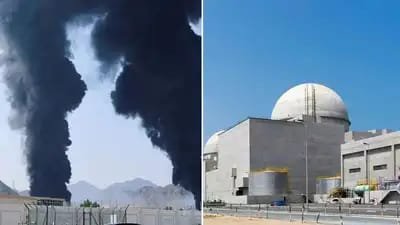
ABU DHABI — In a dramatic escalation of regional tensions, a hostile drone successfully breached the United Arab Emirates’ airspace on Sunday, striking an electrical generator just outside the inner perimeter of the Barakah Nuclear Power Plant. The UAE Ministry of Defence confirmed that its air defense systems engaged three inbound drones entering from the western border. While two were intercepted, the third bypassed defenses to hit the facility’s auxiliary infrastructure, triggering a localized fire. The UAE has strongly condemned the incident as an “unprovoked terrorist attack,” marking a significant shift in the region’s security landscape as global energy markets react to the first-ever strike near the country’s multi-billion-dollar commercial nuclear asset.
The Abu Dhabi Media Office confirmed that emergency response teams were deployed immediately to the Al Dhafra region, successfully containing the blaze. Authorities reported no casualties, injuries, or structural damage to the core reactor units. In the immediate aftermath of the strike, the UAE’s independent nuclear regulator and the Federal Authority for Nuclear Regulation (FANR) conducted exhaustive technical assessments, confirming that radiological safety remains entirely unaffected and all units continue to operate normally.
The International Atomic Energy Agency (IAEA) in Vienna was quickly briefed on the situation. IAEA Director-General Rafael Grossi confirmed that while one auxiliary generator had been damaged, the plant’s essential safety systems functioned exactly as designed, with emergency diesel backups seamlessly maintaining power to the affected subsystems. Grossi strongly condemned the incident, emphasizing that military activity threatening nuclear infrastructure is entirely unacceptable under international law.
The Barakah facility, located roughly 200 kilometers west of Abu Dhabi near the borders of Saudi Arabia and Qatar, began its commercial operations in 2020 and supplies approximately 25 percent of the oil-rich federation’s domestic electricity needs. Following the incident, UAE Foreign Minister Sheikh Abdullah bin Zayed Al Nahyan held urgent telephonic discussions with international counterparts, declaring that the UAE retains the full, sovereign right to protect its critical infrastructure and will not tolerate external threats to its national security.
While no regional group has officially claimed responsibility for the Sunday morning strike, the geopolitical fallout was instantaneous. Dr. Anwar Gargash, presidential diplomatic adviser, stated on social media that the operation represented an unacceptable act of aggression, pointing to the risk of proxy-driven instability. In a show of regional solidarity, neighboring Saudi Arabia strongly condemned the attack, revealing that its own air defense forces concurrently intercepted three separate drones attempting to violate Saudi airspace from an Iraqi direction.
The security breach has sent shockwaves through international commodity markets. Brent crude and West Texas Intermediate (WTI) both surged by over 5 percent in early Monday trading, pushing global benchmarks past the $110-a-barrel mark amid fears that escalating frictions could disrupt maritime traffic through the vital Strait of Hormuz.
The attack has also drawn sharp reactions from major global partners. India’s Ministry of External Affairs voiced deep concern, labeling the targeting of a civil nuclear site as a violation of international norms and calling for an immediate return to diplomatic dialogue. Meanwhile, across the Atlantic, the White House confirmed that emergency national security briefings are underway to evaluate the shifting security dynamics in West Asia, adding immense pressure to an already fragile regional security landscape.