Trump Arrives in China for Landmark Summit With Xi Jinping Amid Rising Global Tensions
 By hanif sabir
Published: 14 May 2026
Updated: 29 Jun 2026
6 min read
By hanif sabir
Published: 14 May 2026
Updated: 29 Jun 2026
6 min read
Trade disputes, Iran conflict, Taiwan crisis, artificial intelligence and global economic stability dominate high-stakes Beijing talks
BEIJING/WASHINGTON: U.S. President Donald Trump arrived in Beijing on Wednesday for a landmark state visit to China, marking the first official trip of his second presidential term and setting the stage for one of the most consequential diplomatic summits in recent years.
Chinese President Xi Jinping welcomed President Trump with full state protocol at a time when relations between the world’s two largest economies remain strained over trade disputes, technological competition, military tensions in Asia and the rapidly evolving crisis in the Middle East.
The summit, being closely watched by governments, financial markets and diplomatic observers across the globe, is expected to influence international politics, economic policy and strategic alliances for years to come.
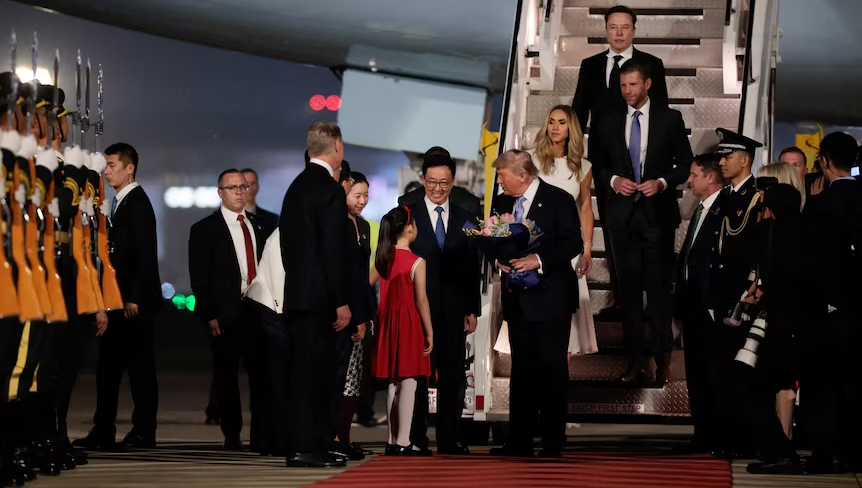
President Trump landed at Beijing Capital International Airport aboard Air Force One, where he was received by Chinese Vice President Han Zheng, senior Communist Party officials and military representatives. The arrival ceremony included a guard of honor, traditional cultural performances and children waving American and Chinese flags, underscoring Beijing’s effort to project stability and diplomatic openness despite deep strategic disagreements between the two powers.
Chinese state media described the visit as an opportunity to “reset and stabilize” bilateral relations, while officials in Washington characterized the trip as a critical mission aimed at protecting American economic interests and reducing geopolitical risks.
A powerful delegation has accompanied President Trump to Beijing, including U.S. Secretary of State Marco Rubio, senior trade negotiators, national security advisers and executives from major American technology and manufacturing firms. Industry leaders connected to artificial intelligence, semiconductor production and advanced communications systems are also participating in meetings with Chinese counterparts.
According to diplomatic sources, the White House hopes to secure broader access for American companies operating in China while addressing long-standing concerns over intellectual property rights, market restrictions and what Washington describes as unfair trade practices.
Trade remains one of the central issues dominating the summit. Over the past several years, the United States and China have imposed tariffs and economic restrictions worth hundreds of billions of dollars on each other’s exports, disrupting global supply chains and creating uncertainty in international markets.
President Trump is reportedly pushing for significant reductions in trade barriers facing U.S. agricultural, technology and financial companies. American officials are also seeking guarantees regarding the protection of intellectual property and fair treatment for U.S. investors in Chinese markets.
Chinese officials, however, are expected to demand the easing of American export controls on advanced semiconductor technology and artificial intelligence systems. Beijing has repeatedly criticized Washington’s restrictions on high-tech exports, arguing that such measures are aimed at slowing China’s technological rise and economic modernization.
The issue of artificial intelligence has become particularly sensitive during the current summit. Both countries are aggressively competing for leadership in AI research, military applications and global digital infrastructure. U.S. technology executives accompanying President Trump are believed to be exploring potential agreements related to market access, data regulations and cooperation in non-military AI development.
Analysts believe that even limited progress in this area could have a major impact on global technology markets and future innovation partnerships.
Another major focus of the summit is the ongoing conflict involving Iran and the broader instability in the Middle East. U.S. officials are urging China to use its economic and diplomatic influence over Tehran to help prevent further escalation in the region.
China remains one of Iran’s most important economic partners and has maintained close diplomatic ties with the Iranian leadership despite increasing tensions between Tehran and Western powers.
Sources familiar with the discussions indicate that Washington wants Beijing to support international efforts aimed at reducing military escalation and stabilizing global energy markets. Rising tensions in the Middle East have already affected oil prices, shipping routes and investor confidence worldwide.
Chinese officials have signaled that Beijing is willing to play a constructive diplomatic role but insists that any long-term solution must involve broader international dialogue rather than unilateral pressure.
Taiwan has emerged as another critical and highly sensitive issue in the talks. In recent months, China has increased military exercises and naval patrols around Taiwan, raising fears of a possible confrontation in the Indo-Pacific region.
The United States continues to strengthen security and defense cooperation with Taiwan, a move Beijing strongly opposes under its “One China Policy.”
During the summit, Chinese leaders are expected to seek assurances that Washington will avoid actions perceived as encouraging Taiwanese independence, while American officials are emphasizing the need to preserve regional stability and freedom of navigation in international waters.
Security analysts believe Taiwan remains the most dangerous flashpoint in U.S.-China relations, with even minor diplomatic miscalculations capable of triggering a broader regional crisis.
Global financial markets are reacting cautiously to the summit. Investors and multinational corporations are hoping for signs of improved communication and reduced tensions between Washington and Beijing after years of uncertainty that affected manufacturing, technology, shipping and currency markets.
Economists say a breakthrough on trade or technology cooperation could help stabilize global growth at a time when many economies are already struggling with inflation, slowing industrial production and geopolitical instability.
Beijing has implemented extraordinary security measures during President Trump’s visit. Several major roads have been temporarily closed, additional police units deployed across the capital and strict security zones established around government buildings, hotels and diplomatic venues.
International media organizations from around the world are covering the summit extensively, while discussions surrounding the visit continue to dominate Chinese and American social media platforms.
Some analysts view the summit as a potential turning point capable of preventing a deeper geopolitical divide between East and West. Others remain skeptical, arguing that strategic competition between the United States and China has become too deeply rooted for any immediate breakthrough.
The visit was originally planned for April 2026 but was postponed because of escalating tensions in the Middle East and the growing Iran crisis. Diplomatic sources now expect the current two-day summit to conclude with several joint statements, economic understandings and possible agreements on future diplomatic engagement.
Whether the meetings ultimately produce lasting progress or only temporary stability, political observers agree that the Trump-Xi summit represents one of the defining geopolitical moments of 2026.
The outcome of the talks is likely to shape the future of international trade, technological competition, regional security and global diplomacy for years to come.