Washington, August 18: US President Donald Trump lashed out at CNN White House correspondent Kristen Holmes during a media interaction at the White House
 By abdullah
Published: 18 Aug 2026
4 min read
By abdullah
Published: 18 Aug 2026
4 min read
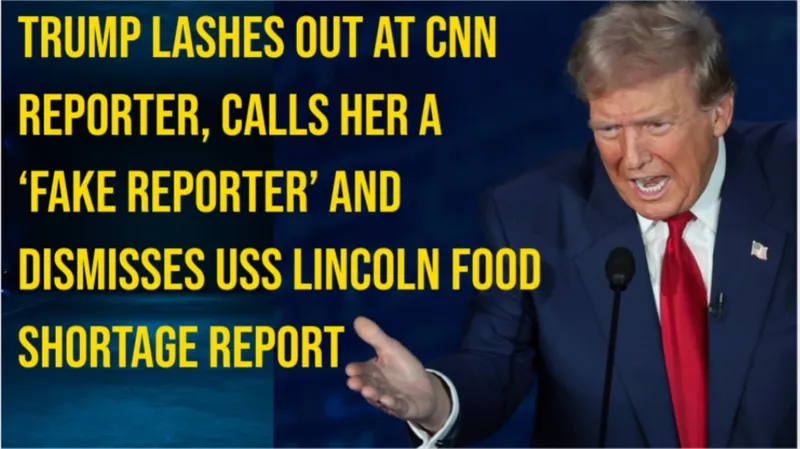
Washington, August 18: US President Donald Trump lashed out at CNN White House correspondent Kristen Holmes during a media interaction at the White House, repeatedly telling her to be quiet and branding CNN’s reporting as “fake news” after she questioned him about South Korea and US military exercises.
The confrontation took place on August 17 in the Oval Office during an interaction with reporters. Holmes questioned Trump about his decision to reduce US-South Korean military exercises and sought to establish whether North Korean leader Kim Jong Un had asked him to scale back the drills.
Rather than directly answering the question, Trump defended his relationship with Kim and his policy toward North Korea. When Holmes continued asking questions, Trump became visibly irritated and told her to “be quiet,” before attacking CNN’s reporting and calling her a “fake reporter.”
The exchange came against the backdrop of Trump’s decision to order a reduction in joint US-South Korean military exercises. The move has attracted considerable attention because the annual Ulchi Freedom Shield exercises are regarded as an important component of the US-South Korea alliance and military readiness on the Korean Peninsula.
Trump has cited financial considerations and South Korea’s level of support for US policies as reasons for wanting changes to the military exercises. He has also repeatedly highlighted his relationship with Kim Jong Un, arguing that his personal diplomacy with the North Korean leader has helped reduce tensions.
Holmes’ question therefore touched on a politically sensitive issue: whether the reduction in military exercises was connected in any way to North Korea’s longstanding demand that the United States scale back military activities with South Korea.
The confrontation then moved to another controversial issue involving the US Navy’s aircraft carrier USS Abraham Lincoln.
A reporter asked Trump about reports concerning conditions aboard the carrier, including claims that sailors had faced shortages of food during the vessel’s unusually prolonged deployment.
Trump rejected the reports and said everything aboard the USS Abraham Lincoln was fine. He specifically accused CNN of publishing a “fake report” about the alleged food shortage.
The issue has attracted attention because the USS Abraham Lincoln has been involved in an unusually lengthy deployment. Reports have raised concerns about supplies, living conditions, sanitation and the physical and psychological strain placed on sailors after months at sea.
US media reports have also cited concerns among sailors and their families over the prolonged deployment and the difficulties associated with maintaining normal living conditions during an extended military operation.
Trump, however, dismissed those concerns and stood by the Navy’s handling of the carrier, turning his criticism once again toward CNN.
The incident was significant not only because of the president’s confrontation with a journalist but also because the White House and Trump’s political allies have repeatedly attacked CNN and other mainstream media organizations over their coverage of his administration.
The exchange with Holmes quickly became a major media story, with the president’s remarks drawing renewed attention to the increasingly combative relationship between Trump and the US press.
The confrontation also highlighted the broader political tensions surrounding Trump’s foreign and defense policies. His administration is simultaneously dealing with major military commitments in the Middle East, reassessing the US military posture toward traditional allies and pursuing a different approach to North Korea.
The South Korea issue is particularly sensitive because any reduction in joint military exercises could affect deterrence against North Korea and raise questions about the future role of US forces on the Korean Peninsula.
Meanwhile, the USS Abraham Lincoln controversy raises a different but equally serious question: whether prolonged military deployments are placing excessive pressure on US service members and whether the Pentagon is adequately addressing concerns about their welfare.
Trump’s dismissal of the reports as “fake” has therefore intensified the debate rather than ended it.
The August 17 confrontation ultimately became more than a heated exchange between a president and a journalist. It brought together three contentious issues facing the Trump administration: Washington’s changing defense relationship with South Korea, the impact of extended military deployments on American sailors, and the increasingly hostile relationship between the White House and major US news organizations.
The clash with CNN’s Kristen Holmes has consequently emerged as another prominent episode in Trump’s long-running battle with the mainstream American media, while the controversy surrounding the USS Abraham Lincoln continues to raise questions about the conditions facing US service members deployed for extended periods.