EU, UK Envoys Back Pakistan’s Right to Self-Defense Against TTP
 By abdullah
Published: 25 Jun 2026
Updated: 29 Jun 2026
4 min read
By abdullah
Published: 25 Jun 2026
Updated: 29 Jun 2026
4 min read
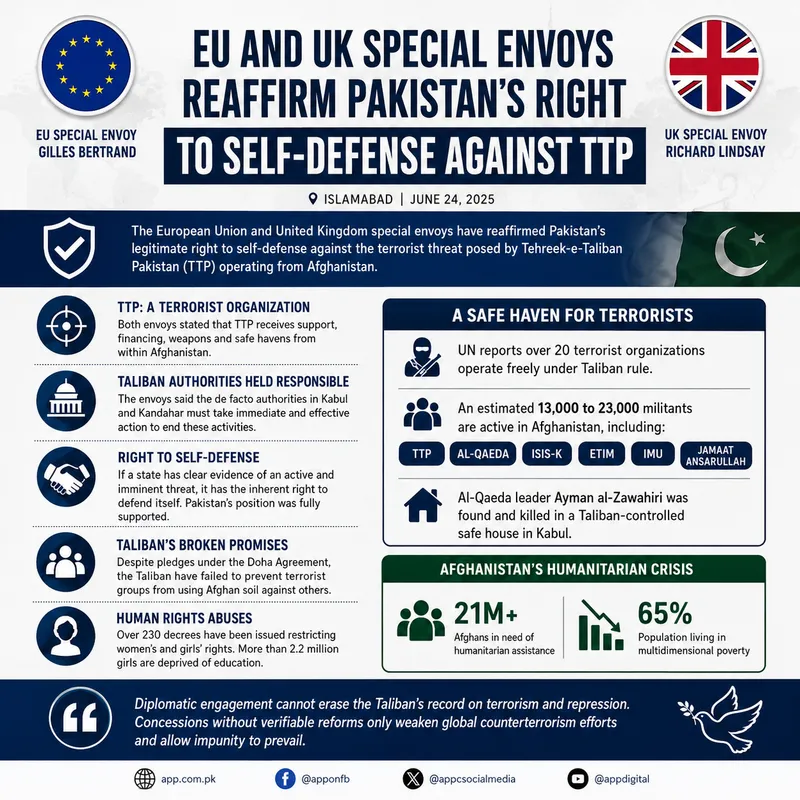
ISLAMABAD (special crosspondent) – Special envoys from the European Union and the United Kingdom have unequivocally reaffirmed Pakistan’s right to self-defense in the face of the persistent terrorist threat posed by the Tehreek-e-Taliban Pakistan (TTP). Gilles Bertrand, the European Union ‘s Special Envoy, and Richard Lindsay, his counterpart from the United Kingdom, explicitly acknowledged Pakistan ‘s legitimate right to defend itself against immediate terrorist dangers originating from Afghanistan.
Criticism of Taliban Authorities
Both envoys sharply criticized the current Taliban authorities for their perceived failure to dismantle terrorist safe havens that continue to operate with impunity within Afghan territory. They reiterated that the TTP is designated as a terrorist organization and persistently receives substantial cross-border support, including financing, weaponry, and sanctuary, from within Afghanistan. The representatives emphasized that the authorities presently in power in Kabul and Kandahar bear the ultimate responsibility for curbing these activities and must implement immediate and effective measures to prevent Afghan soil from being utilized for launching attacks against neighboring nations. The TTP has been exploiting training facilities, arms supply networks, and safe havens inside Afghanistan to evade Pakistani security forces, thereby posing a significant threat to regional peace and stability.
International Support for Pakistan’s Position
When questioned about Pakistan’s military response to these escalating threats, both special envoys voiced support for Islamabad’s stance. They stated that any state possessing clear and verifiable evidence of an active and imminent threat possesses the inherent right to defend itself. The growing international frustration with the Taliban administration emerges against a backdrop of reports indicating its failure to uphold its commitments related to global security. Under the Doha Agreement, the Taliban had pledged not to grant sanctuary to terrorist entities and to ensure that Afghan territory would not be used for hostile actions against other countries. However, nearly five years after their resurgence to power, the Taliban are widely accused of breaching numerous key political, security, and governance commitments.
Terrorist Presence in Afghanistan
According to reports compiled by the United Nations Security Council Monitoring Team, an estimated 20 or more terrorist organizations continue to operate with considerable freedom under Taliban oversight. These groups are believed to comprise between 13,000 and 23,000 active militants within Afghanistan. The roster of these organizations includes the TTP, Al-Qaeda, ISIS-Khorasan (ISKP), the East Turkestan Islamic Movement (ETIM), the Islamic Movement of Uzbekistan (IMU), and Jamaat Ansarullah. The Taliban’s claims regarding counterterrorism efforts have been further undermined by the revelation that Al-Qaeda leader Ayman al-Zawahiri was harbored and subsequently killed in a Taliban-controlled safe house located in central Kabul. This incident has amplified concerns that some of the world’s most wanted terrorists continue to find refuge under the current Afghan administration.
Human Rights and Humanitarian Concerns
Beyond the critical issue of terrorism, the Taliban government has also faced accusations of instituting a system of state-sponsored discrimination and repression. Reports indicate that over 230 decrees have been issued, severely restricting the rights of women and girls—measures that international experts have characterized as constituting
“gender-based apartheid.”
More than 2.2 million Afghan girls are currently denied access to secondary and higher education. Concurrently, women encounter stringent limitations on their employment opportunities, freedom of movement, and their ability to participate in public life. Compounding these issues, internal mismanagement has significantly contributed to a deepening humanitarian crisis, with an estimated 21 million Afghans requiring urgent humanitarian assistance. This situation is exacerbated by the fact that nearly 65 percent of the population is experiencing multidimensional poverty, a direct consequence of discriminatory and ideological policies.
Diplomatic Engagement and Accountability
The international envoys underscored that ongoing diplomatic engagement should not serve to obscure the Taliban’s concerning track record on terrorism and human rights. They issued a stern warning that extending concessions to the Taliban without demonstrable and verifiable reforms risks undermining global counterterrorism initiatives and diluting accountability for the regime’s continued violations.