Netanyahu Rejects US Pressure for Military Withdrawal from Regional Conflict
 By abdullah
Published: 27 Jul 2026
3 min read
By abdullah
Published: 27 Jul 2026
3 min read
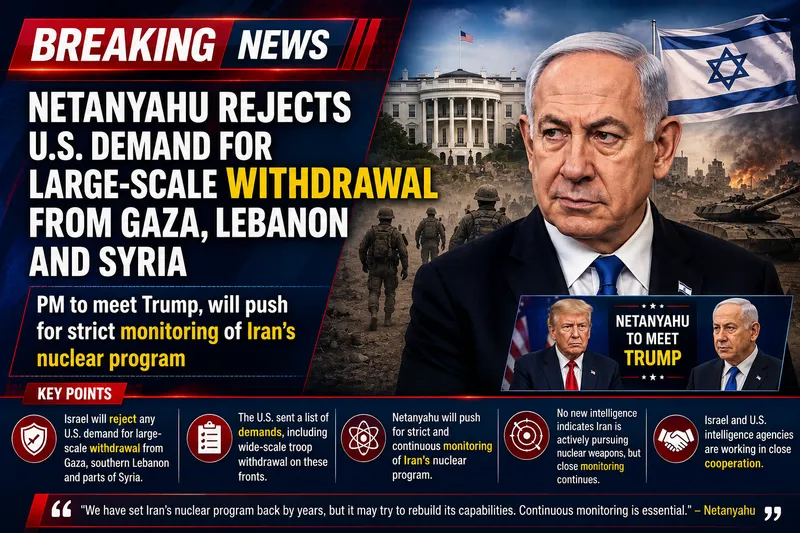
TEL AVIV (special crosspondent) – Israeli Prime Minister Benjamin Netanyahu has informed his security cabinet that he intends to reject any United States request for a large-scale withdrawal of Israeli forces from Gaza, southern Lebanon, and parts of Syria during his forthcoming meeting with US President Donald Trump. Netanyahu underscored that Israel remains steadfast in its refusal to compromise on fundamental decisions concerning its national security.
According to reports in the Israeli media, the Prime Minister conveyed to his cabinet that Washington has submitted a list of proposals, which includes a formal request for a broad military withdrawal across the aforementioned conflict zones. Netanyahu stated that he would firmly oppose these suggestions, signalling a clear refusal to accede to the American position. The developments unfold as Syria seeks security deal with Israel while maintaining Golan claim, adding a complex layer to regional negotiations.
Focus on Iran’s Nuclear Programme
The upcoming high-level meeting between Netanyahu and President Trump is expected to cover a wide array of regional concerns, including the war in Gaza, the broader security situation in the Middle East, and the trajectory of Iran’s nuclear programme. Netanyahu articulated his intention to urge President Trump to maintain stringent and continuous monitoring of Iran’s nuclear activities. While the Prime Minister acknowledged that Israel possesses no new intelligence suggesting that Tehran is currently attempting to rebuild its nuclear weapons capability, he stressed that such a possibility cannot be dismissed.
Netanyahu noted that Israeli and US intelligence agencies continue to maintain close cooperation. Both nations are actively sharing intelligence to ensure that any renewed attempts by Tehran to advance sensitive nuclear initiatives are detected and countered promptly. He further claimed that previous targeted strikes on Iranian facilities had effectively delayed their nuclear programme by several years; however, he warned that the potential for Tehran to restore these capabilities makes continued international vigilance essential.
Strategic Implications for the Middle East
The Prime Minister stated that President Trump’s position on Iran remains of critical importance and that he anticipates detailed discussions on the subject. Nevertheless, he acknowledged that any substantive future US policy or action regarding the Islamic Republic will ultimately rest upon the decisions of the American administration. While international powers navigate these tensions, global observers monitor how nations like Saudi Arabia coordinate security efforts with Türkiye and South Africa to maintain regional stability.
Political analysts suggest that Netanyahu’s comments underscore Israel’s unwavering determination to maintain its military presence in Gaza, southern Lebanon, and parts of Syria, positions deemed vital for its national security. As the international community watches, many recall that Pakistan condemns remarks of Indian defense minister regarding similar cross-border tensions, reflecting the global sensitivity toward territorial integrity. Observers maintain that the forthcoming summit could have profound implications for the future security landscape of the Middle East.