Syria Seeks Security Deal With Israel While Maintaining Golan Claim
 By abdullah
Published: 27 Jul 2026
3 min read
By abdullah
Published: 27 Jul 2026
3 min read
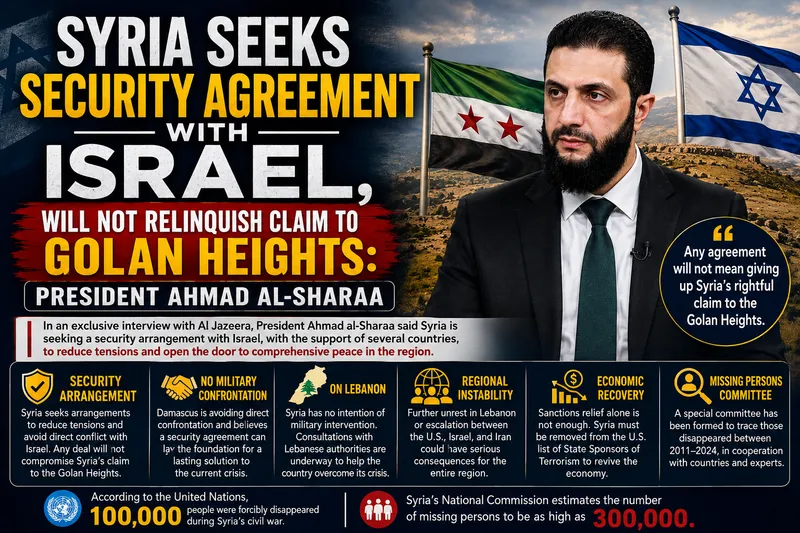
DAMASCUS (special crosspondent) – Syrian President Ahmad al-Sharaa has announced that his administration is actively engaging with various regional and international partners to facilitate a security agreement with Israel. While framing this initiative as a crucial mechanism to de-escalate regional tensions and foster long-term peace in the Middle East, he explicitly maintained that such diplomatic efforts do not signify a relinquishment of Syria’s territorial claims over the Israeli-occupied Golan Heights.
Pursuing Regional Security and Stability
In an exclusive interview, President al-Sharaa underscored that Damascus is prioritizing security frameworks designed to mitigate military friction and prevent future escalations. This stance aligns with recent shifts in regional security dynamics, similar to the complex legal and security arrangements discussed in other Middle Eastern conflict zones. He noted that a well-structured agreement, supported by robust international guarantees, remains essential for a viable political resolution. The Syrian leadership continues to emphasize that direct military confrontation would prove counterproductive to regional stability.
The Legacy of Conflict and Current Challenges
These diplomatic overtures follow a period of heightened military activity, with Israel conducting airstrikes across southern Syria since the collapse of the Bashar al-Assad administration in December 2024. Damascus has consistently decried these incursions as breaches of national sovereignty. Regarding Lebanon, President al-Sharaa affirmed that Syria maintains no intent for military intervention, favoring instead a policy of consultation to assist the neighbouring state in navigating its multifaceted crises. He reiterated that national decision-making concerning defense and security must reside solely with the Lebanese state.
Economic Recovery and Geopolitical Realignment
Addressing the domestic economic crisis, the President argued that the simple removal of international sanctions is insufficient. He advocated for the immediate de-listing of Syria from the United States’ State Sponsors of Terrorism list, asserting that such a move is a prerequisite for reintegrating into the global banking system and stimulating necessary foreign investment for reconstruction. These broader geopolitical shifts reflect the complex path toward recovery for the nation following the turbulence of the 2011-2024 civil war.
Domestic Reconciliation and Missing Persons
On the internal front, the administration remains committed to its existing agreement with the Syrian Democratic Forces (SDF) to re-establish state authority across northern and eastern territories. Furthermore, President al-Sharaa has officially established a special national committee tasked with investigating the fate of individuals who disappeared during the years of conflict. This initiative is expected to align with international standards. Current estimates provided by the United Nations suggest that approximately 100,000 individuals were forcibly disappeared, though national assessments indicate the figure could reach 300,000. Resolving this humanitarian crisis is regarded as a vital component of the broader national reconciliation process.