Israel Approves Legal Framework for International Security Force in Gaza
 By abdullah
Published: 27 Jul 2026
2 min read
By abdullah
Published: 27 Jul 2026
2 min read
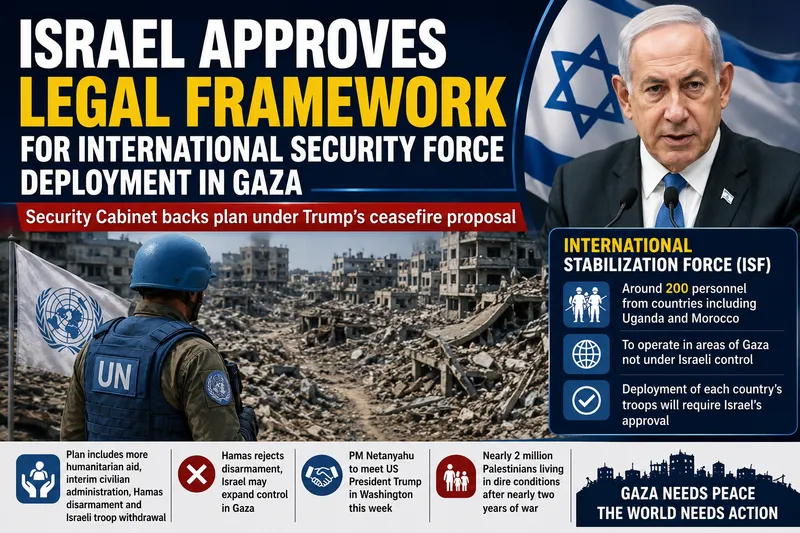
TEL AVIV (special crosspondent) – Israel has formally approved a legal framework facilitating the potential deployment of an international security force within the Gaza Strip as a core component of the ceasefire proposal championed by US President Donald Trump, according to regional media reports. This development marks a significant shift in diplomatic efforts aimed at stabilizing the war-torn enclave.
Approval of the International Stabilization Force
The Israeli Security Cabinet has officially endorsed the legislative framework required to integrate an International Stabilization Force (ISF) into the operational landscape of Gaza. Under the current terms of the proposal, the contingent is expected to consist of approximately 200 personnel sourced from nations maintaining diplomatic ties with Israel, including Uganda and Morocco. Strategic provisions mandate that these international forces will operate strictly in sectors of Gaza currently outside the scope of direct Israeli military control. Furthermore, the deployment of any individual nation’s personnel is subject to explicit prior approval by the Israeli government.
Diplomatic Engagements and Strategic Challenges
In anticipation of further negotiations, Israeli Prime Minister Benjamin Netanyahu is slated to travel to Washington to hold high-level discussions with US President Donald Trump. Their dialogue is expected to center on the evolving security situation in Gaza and the technicalities of the proposed ceasefire framework. Similar to how international entities manage complex regional crises—as seen in recent discussions regarding regional stability—the path forward remains fraught with diplomatic and logistical hurdles.
Humanitarian Conditions and Implementation Status
The US-backed initiative outlines a comprehensive roadmap, which includes a substantial increase in humanitarian aid, the formation of an interim civilian administration governed by Palestinian technocrats, the complete disarmament of Hamas, and the systematic withdrawal of Israeli Defense Forces. Despite these proposals, the implementation phase remains significantly stalled. Hamas has categorically rejected the disarmament requirements, while Israeli officials have signaled potential plans to expand the territorial scope of their ongoing military operations within Gaza. The ongoing conflict, now approaching its second year, has left approximately two million Palestinians in dire humanitarian conditions, with displaced populations residing in makeshift tents or heavily damaged infrastructure.