Israel, Lebanon, US Forge Historic Trilateral Framework Agreement
 By abdullah
Published: 27 Jun 2026
Updated: 29 Jun 2026
2 min read
By abdullah
Published: 27 Jun 2026
Updated: 29 Jun 2026
2 min read
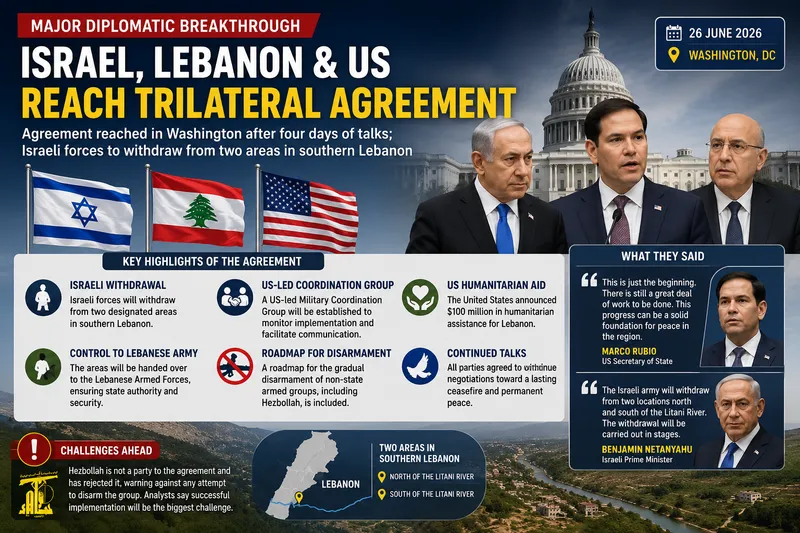
ISLAMABAD (special crosspondent) – In a significant diplomatic achievement for the Middle East, Israel, Lebanon, and the United States have concluded a trilateral framework agreement after four days of intense negotiations in Washington. Officials hailed the accord as a crucial stride towards enduring regional stability.
US Secretary of State Marco Rubio announced the deal in the presence of the Israeli and Lebanese ambassadors to Washington, stating that the agreement marked “just the beginning” and acknowledging that “there is still a great deal of work to be done” to secure lasting peace.
Phased Israeli Withdrawal from Southern Lebanon
The framework agreement stipulates a phased withdrawal of the Israeli military from two specified zones in southern Lebanon. Responsibility for security and stability in these areas will be transferred to the Lebanese Armed Forces.
Israeli Prime Minister Benjamin Netanyahu affirmed that Israeli forces would withdraw from two locations north and south of the Litani River, assuring that the pullback would be conducted in stages while safeguarding Israel’s security needs.
US-Led Coordination Group and Disarmament Roadmap
The agreement also establishes a US-led Military Coordination Group tasked with overseeing the accord’s implementation, monitoring security arrangements, and facilitating inter-party communication.
A particularly significant and sensitive component of the framework outlines a plan for the gradual disarmament of non-state armed groups operating in Lebanon, notably including Hezbollah. However, Hezbollah, which is not a signatory to the agreement, has already voiced its rejection of the framework, cautioning that any forceful disarmament efforts could incite significant political and security repercussions within Lebanon.
US Humanitarian Aid and Diplomatic Outlook
The United States additionally pledged $100 million in humanitarian assistance to Lebanon, aimed at supporting recovery initiatives and aiding communities impacted by conflict.
Diplomatic observers view the agreement as a vital confidence-building measure between Israel and Lebanon. Nevertheless, they express caution, noting that the accord’s ultimate success hinges on effective execution and the parties’ capacity to navigate complex security and political challenges, especially concerning Hezbollah. Analysts suggest that successful implementation could foster broader de-escalation between Israel and Lebanon, thereby contributing to enhanced peace and stability across the broader Middle East region. The potential for regional de-escalation echoes recent developments that have seen Middle East tensions ease, impacting global oil prices.