Saudi Crown Prince Rejects Trump’s Iran War Strategy, U.S. Plan Falters
 By abdullah
Published: 02 Jul 2026
4 min read
By abdullah
Published: 02 Jul 2026
4 min read
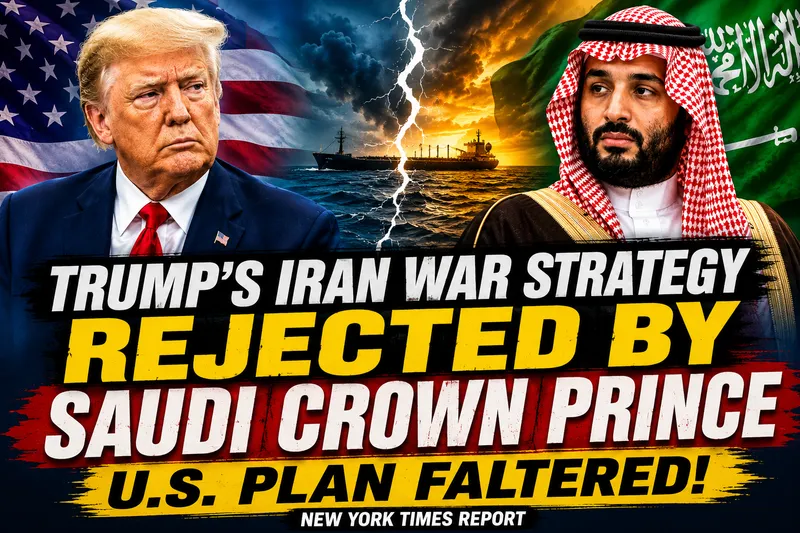
WASHINGTON (special crosspondent) – Sharp divergences emerged between U.S. President Donald Trump and Saudi Crown Prince Mohammed bin Salman during recent deliberations concerning a potential Iran war, reportedly leading to an unprecedented strain in relations between the two long-standing allies, according to a report by The New York Times.
U.S. Military Operation Scaled Back
The newspaper detailed that the United States had developed a military operation, internally codenamed “Project Freedom,” intended to safeguard commercial shipping traversing the Strait of Hormuz. However, Saudi Arabia ultimately declined to grant U.S. forces access to its airspace and military facilities. This refusal necessitated a significant scaling back of the American operation, impacting its intended scope and effectiveness.
Diplomatic Efforts Fail to Persuade Saudi Arabia
According to The New York Times, President Trump and Crown Prince Mohammed bin Salman engaged in multiple telephone conversations to address the contentious issue. Further attempts to persuade the Saudi leadership to alter their position were reportedly made by U.S. Vice President J.D. Vance, Special Envoy Steve Witkoff, Jared Kushner, and Secretary of State Marco Rubio. Despite these concerted efforts, the Crown Prince remained resolute in upholding Riyadh’s stance.
Saudi Concerns Over Escalation
The report indicated that Saudi leaders harboured concerns that providing direct support to U.S. military operations could expose the Kingdom to retaliatory Iranian missile and drone attacks. Consequently, Riyadh opted to avoid direct involvement in the conflict, prioritizing measures to prevent further regional escalation. This strategic choice underscored Saudi Arabia’s cautious approach amidst rising tensions.
Shift Towards Diplomatic Settlement
While The New York Times reported that Mohammed bin Salman initially favoured a more assertive stance against Iran, the escalating conflict and heightened regional risks prompted a strategic shift. Saudi Arabia began to focus on achieving a ceasefire and pursuing a diplomatic settlement. Officials from the Kingdom also refuted claims that the Crown Prince had advocated for Washington to prolong the war, suggesting a desire for de-escalation.
Balanced Strategy Amidst Tensions
Throughout the period of heightened tension, Saudi Arabia reportedly pursued a balanced strategy. This involved maintaining close communication channels with the United States while simultaneously keeping diplomatic avenues open with Iran. This dual approach aimed to mitigate the risk of a broader regional confrontation. This delicate balancing act reflects Saudi Arabia’s complex regional diplomacy.
Direct Talks with Tehran
The report further revealed that Riyadh is presently engaged in direct discussions with Tehran. These talks focus on issues deemed critical to Saudi Arabia’s national security, including the security of the Strait of Hormuz, Iran’s ballistic missile program, and the activities of Tehran-backed armed groups operating throughout the region. These direct engagements signal a significant shift in regional diplomatic dynamics.
Growing Independent Foreign Policy
The New York Times also highlighted Saudi Arabia’s increasingly independent foreign policy trajectory in recent years. This includes the expansion of relations with China and other international partners. The report further suggested that the U.S. response to the 2019 attacks on Saudi oil facilities may have diminished Riyadh’s confidence in Washington’s security commitments, contributing to this independent foreign policy shift. Such developments come amidst ongoing discussions about regional security and cooperation, including the potential for enhanced transport ties with countries like Iran.
Continued Cooperation Despite Differences
Despite the noted policy disagreements concerning the Iran conflict, the report stated that defense and economic cooperation between the United States and Saudi Arabia are continuing. Nevertheless, the recent events surrounding the Iran war have evidently exposed significant policy differences between these two strategic allies, underscoring the evolving geopolitical landscape and the need for recalibrated alliances in the Middle East, a region often influenced by fluctuating oil prices, such as those seen during periods of Middle East Tensions.
The New York Times report.